From “We Think” to “We Know”: Building an Evidence-Based View of Control.
When organisations uncover gaps in control, the default response is usually to buy another system. A new application is brought in for inspections, a fresh module is added to the existing platform, or a niche solution is sold internally as the missing piece that will finally close the gaps. In practice, this behaviour often increases complexity without meaningfully improving control. Each new tool captures another slice of the truth. Safety teams work in one system, maintenance in another, HR in a third, and project teams in yet another. Contractors bring their own portals, and spreadsheets and email fill every gap in between. Staff end up entering similar information multiple times across multiple platforms. Data quality deteriorates, and reporting turns into an exercise in collecting exports, reconciling conflicting numbers and chasing clarifications by email and phone.
In this environment, critical tasks can sit in the cracks between systems. No single platform “knows” that a particular inspection is both safety-critical and maintenance-related. No single report makes it clear that a high-risk site has overdue training, incomplete inspections and a long-standing equipment defect, all at the same time, because each of those elements is owned by a different system and a different team. The organisation may look more digital and more sophisticated, but it does not necessarily become safer.
A better starting point is not to ask what else can be bought. The better question is: what do we need to know, and how can we prove it? Boards, executives and regulators should be able to ask, and receive clear answers to, questions such as which specific tasks and behaviours keep people, the community and assets safe; where these tasks live today; who is accountable for each of them; how everyone can be confident they have been completed on time and to the required standard; how quickly the organisation can see when a critical control is weak or failing; and whether there is a clear line of sight from Board-approved risk appetite and policy through to what a supervisor or contractor actually does on site on any given day.
If those questions can only be answered with heroic effort, spreadsheets and manual follow-up, then the organisation is operating in much the same mode as those that suffered the disasters outlined in the previous blog. It may be more modern and more data-rich, but it is still relying on belief instead of real-time evidence. This is the problem Unifii Operations Cloud® was created to address. Unifii Operations Cloud® is not just another system in the pile. It is a platform that connects the systems, people and processes you already have and turns them into a consistent, defensible picture of control. The work begins with understanding how your organisation operates, not how the procedures claim it does. That involves engaging with the people doing the work, not just reading documents. It requires mapping where tasks live and how they are triggered, identifying who is responsible and which systems are involved, and surfacing the local spreadsheets, email chains and whiteboards that quietly hold up your safety and operational framework.
From there, Unifii helps design a joined-up model of work. Tasks are assigned to real roles and individuals. Each task is linked to the risk or control it supports. Data flows are defined so that information moves across departments and systems without manual duplication. The overall structure makes sense both to the Board and to a frontline supervisor. Because Unifii is configurable rather than hard-coded, this model can be implemented quickly. Digital workflows, forms and views are configured to reflect your operations. Interfaces connect Unifii to your existing systems. A pilot is established with real users, refined based on their feedback, and then scaled across sites and business units. Throughout, the focus remains on outcomes: knowing that critical tasks are being done and being able to prove it.
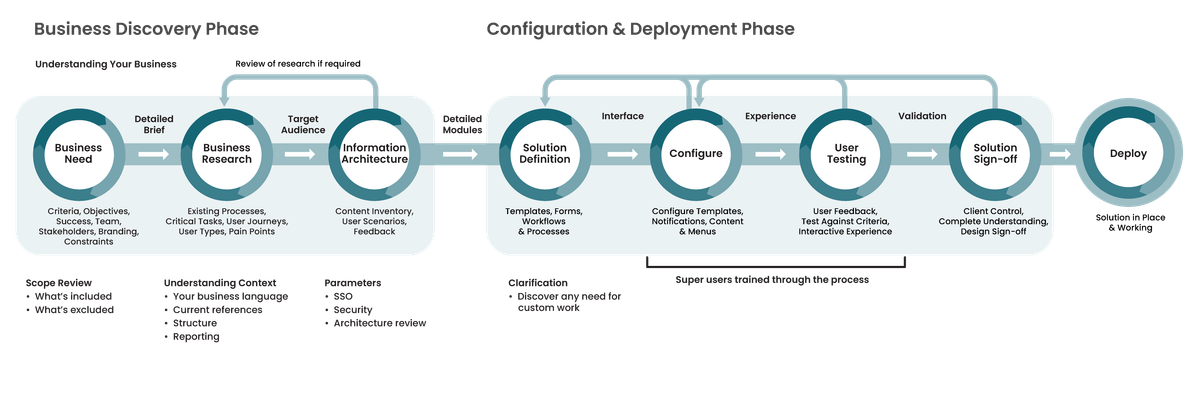
Once the model is in place, it does not remain static. As regulations change, assets are updated and operations evolve, workflows and data structures can be modified without starting again. Dashboards and reports can be adjusted to answer the questions Boards and regulators are asking now, rather than the questions they were asking three years ago. The result is a living operational framework, not a one-off compliance project that gradually drifts out of date.
When you have a connected, evidence-based view of control, the conversation changes at every level of the organisation. Line managers no longer have to rely on scattered lists and personal memory. They can see exactly what needs to be done, by whom and by when across safety, operations and compliance. They can track which items are complete and which are outstanding. They can produce evidence of completion without spending evenings assembling spreadsheets for audits.
Executives are no longer dependent on high-level summaries that hide the detail. They can see which controls are strong and which are under strain, identify patterns of weakness across multiple sites or business units, understand the link between resource decisions and control performance, and test whether the organisation is genuinely operating within its stated risk appetite. Boards and regulators are no longer limited to polished presentations that tell a reassuring story. They can ask for traceable evidence that critical controls are effective, see real operational data rather than opinion and narrative, and sign off on risk statements with a much clearer view of reality.
In this environment, statements such as “we believe our systems are robust” start to sound weak and inadequate. They are replaced by more concrete claims: we know which controls matter most, we know who owns them, we know whether they are working in near real time, and we can demonstrate it with data. That represents a fundamentally different risk posture.
Serious incidents rarely occur because people did not care. They occur because organisations confused belief with evidence. Critical tasks were assumed to be happening but were not. Early signs of trouble were dismissed or lost among competing priorities. Fragmented systems hid important gaps. Leaders trusted incomplete information because it was comforting and familiar. The disasters of the past are not historical curiosities. They are warnings about what happens when Boards and executives are satisfied with a well-presented belief that everything is under control.
The real question for any leader today is: How do we prove we are actually protected when everyone says we are?
If the only honest answer involves faith, manual work and stitched-together reporting, then the organisation is depending on luck, and history continues to demonstrate that luck eventually runs out. The alternative is to build a connected, evidence-based view of control, to make the messy, fragmented reality of your existing systems work together, and to move your organisation from “we think” to “we know”. That is what Unifii Operations Cloud® is designed to provide: a practical, operational way to see and prove that the actions which keep your people, your community and your enterprise safe are actually being done.
Cheers
Stu
